Money / Investing
How I Invest: Passive Index Investing
This is not financial advice. I am not an advisor, not a wealth manager, and I am not selling you anything. People just ask me how I do this all the time, so instead of explaining it over and over, I am writing it down once. What works for me does not have to fit you. Your situation, your country, your tax setup, your risk tolerance are all different. Make your own decisions, and when real money is on the line, get someone who is liable for your specific case.
With that out of the way, here is what I do and why.
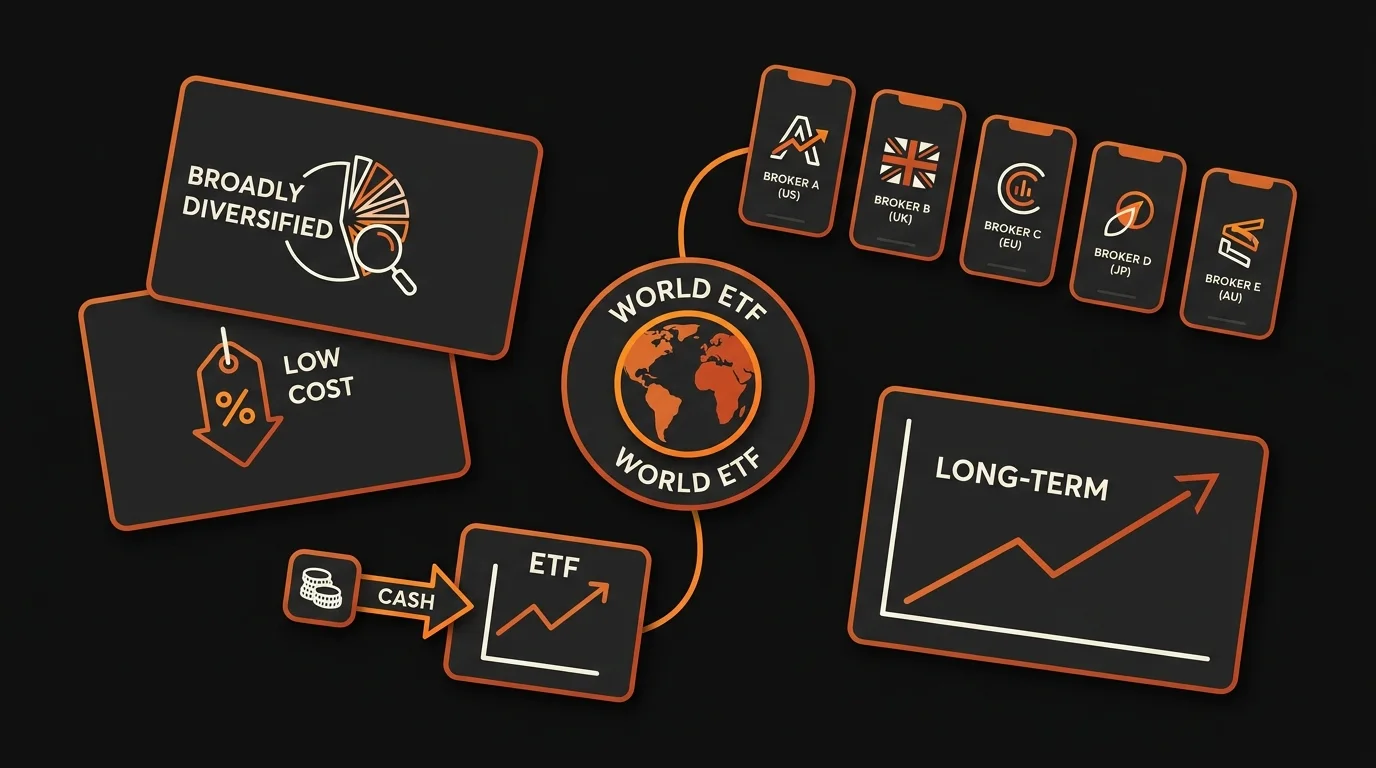
The short version. Almost all of my liquid net worth sits in broadly diversified, low-cost ETFs that simply track the whole world market. I do not try to beat the market, pick stocks, or time my entry. I buy the market as a whole, keep costs low, never let cash sit idle, and spread everything across several brokers in several countries.
Why the stock market at all
Before the question of index funds versus active funds comes the bigger one: why stocks at all, and not bonds, real estate, gold, or something else? For me the answer is the broad public stock market, for concrete reasons.
Liquidity. I can sell my portfolio at the press of a button, in full or in part, at a known price, in seconds. A flat takes weeks to months to sell, only as a whole, with five to ten percent in transaction costs. With an ETF I never have to deal with any of that.
No concentration risk. A single world ETF holds thousands of companies across roughly 50 countries and every sector. A rental flat or your own business is the opposite: one undiversified bet. With the ETF the diversification is built in.
No overhead around it. No management, no maintenance, no insurance, no property tax, no tenants, no vacancies. I buy and hold. And I can see transparently every day what it is worth.
The most important point, which most people miss: when my broadly diversified portfolio really tanks, it is because the world economy is in trouble. And in exactly those moments, real estate, private business stakes, and almost every other asset are down too. The only difference is that they are not priced every second, so they feel calmer. That calm is largely an accounting illusion, not an absence of risk. A property that nobody revalues daily swings less on paper, not in reality.
To be fair: real estate does not move in perfect lockstep with stocks, so a genuine diversification benefit exists. But it is overstated, and in real crises like 2008 both fell together.
What the history shows
The long-run numbers are clear, and they are the real reason I invest this way.
Over the last 125 years (1900 to 2024), global stocks returned roughly 5 percent per year after inflation. Bonds came in around 1.7 percent, cash around 0.5 percent. That sounds like small gaps, but over decades and with compounding it is the difference between building wealth and standing still. The source is the UBS Global Investment Returns Yearbook by Dimson, Marsh and Staunton, the longest serious dataset there is.
One number makes it tangible: one US dollar put into US stocks in 1900 was worth over 100,000 dollars in nominal terms by the end of 2024. The same dollar in bonds reached a few hundred.
US stocks did even better at around 6.5 percent real, but that was the single best market in the whole dataset. So I deliberately take the lower world figure as my honest baseline and do not bank on American exceptional performance repeating. Over the last roughly 50 years the S&P 500 returned about 8 percent per year after inflation, around 12 percent before.
And real estate? Over very long horizons the total return from price plus rent is close to stocks, roughly 7 percent real since 1870, per the study The Rate of Return on Everything. But that is an idealized, unlevered, frictionless landlord return. You cannot buy it as a liquid, diversified position, and its low measured volatility is partly the same pricing illusion as above.
The honest caveats, because they belong here: past returns are no guarantee. Over 200 years the edge of stocks was smaller than in the 20th century. There were stretches of many years with real losses. If you cannot sit through that, this strategy is not for you.
Why index funds, specifically
I do not do this on a hunch. I do it because it is one of the best-evidenced strategies there is, and because the logic holds up cleanly.
Most active funds do not beat the index over the long run. This has been measured for years. The SPIVA studies by S&P show the same thing again and again over long horizons: the large majority of actively managed funds end up below their benchmark after costs. And the few that lead in one period are rarely the same ones in the next.
Costs are the only thing you can reliably control. You do not know in advance which fund will win. You do know exactly what it charges. A broad world ETF costs you somewhere between 0.07 and 0.22 percent a year today. An active fund happily charges 1.5 percent or more. Over decades that gap eats a frightening share of your return, because it compounds. Jack Bogle put it best: “In investing, you get what you don’t pay for.”
The logic is banal, and that is exactly why it is strong. All market participants together own the whole market. On average they can only earn the market return, minus their costs. Anyone who wants more has to win at someone else’s expense. So if I just buy the entire market and pay the least, I land in the upper half systematically. No research, no luck, no stress.
Time in the market beats timing the market. Nobody reliably knows when the next crash or the next rally comes. People who wait for the perfect entry usually miss more return than they save on a crash. So I do not wait. Money in as soon as it arrives.
How I actually do it
Cash position in the low single digits. Almost no money just sits around with me. Whatever comes in and is not needed for running costs goes into ETFs pretty much immediately. I keep a small buffer for emergencies, but the rest should be working, not losing purchasing power in an account.
My liquid net worth is almost entirely in ETFs. I own an apartment in Georgia, but by now it is only a small part of my net worth. The bulk of what I manage day to day is in broadly diversified index funds.
I deliberately spread across several brokers in several countries. This is the part I think matters most and the part most people skip. I use European neobrokers like Trade Republic, Flatex, finanzen.net Zero, and Traders Place, plus Lightyear in the UK, a Georgian broker, and Interactive Brokers.
The reason is not return, it is access and resilience. If something breaks at one provider, an app bug, a technical outage, a locked account, it does not bother me. I can switch to the others at any time. I do not depend on any single provider, any single app, or any single jurisdiction. For someone with an internationally spread life, that is not a luxury, it is a baseline requirement.
How I got here
I took my first small ETF steps back around 2005, with pauses. Back then I was neither really committed nor did I have the financial means to make big moves. I got seriously aggressive about it in 2021. Since then it has been the system above: low cash position, everything into broad ETFs, spread across many brokers.
The honest point: the interesting part did not come from brilliant picks, it came from consistency over time. That is exactly why the strategy works for so many people. It does not require any special talent, just discipline and patience.
If I were starting from zero today
Again, not advice, just how I would approach it myself. I split this by situation, because broker access depends heavily on where you are registered.
You live in a German-speaking country and are registered there
You have the easiest access. A tax-simple broker, one broad world ETF in the accumulating share class, set up a savings plan, done. Examples of the one-fund solution:
- Vanguard FTSE All-World UCITS ETF (Acc: VWCE, around 0.22% ongoing cost)
- Amundi Prime All Country World UCITS ETF (Acc: WEBN, around 0.07%)
- SPDR MSCI ACWI IMI UCITS ETF (includes small caps, around 0.17%)
Which one exactly is secondary. The differences are tiny next to the effect of simply being broadly and cheaply invested at all.
You have left your home country or deregistered
Once you no longer have a residence there, you often lose access to local brokers, and automatic local tax withholding falls away. My approach: brokers that work cleanly without local residence (for example Interactive Brokers, Lightyear, local brokers depending on the country), the same broad UCITS world ETFs, and clarifying upfront how ETF gains are taxed in your new country of residence.
You are international and have no access to EU brokers
If UCITS ETFs are out of reach for you, Interactive Brokers is often the common denominator. There you usually trade US-domiciled world ETFs:
- Vanguard Total World Stock ETF (VT, around 0.06%) as a one-fund solution
- or the combo VTI (US total market) plus VXUS (rest of the world)
Careful: US-domiciled funds have their own tax issues for non-US persons (US withholding tax on dividends, possible US estate tax exposure above certain thresholds). Depending on your passport and residence this can matter. Check first.
As of 2026. All funds named are examples, not recommendations, and their costs and availability change.
What I deliberately do not do
- No single stocks at the core. If at all, then as a small playground, clearly separated from the core. The core is boring and should stay that way.
- No stock picking, no market timing. I do not believe I can do it better than the market over the long run, and the data backs me up.
- No expensive active funds and no advisors who earn on commissions. That eats exactly the return the index approach saves you.
- The trade-off I accept: I will never be the one who made 200 percent on a single stock. But I also never have the total wipeout, the sleepless nights, and the time sink. For me that is a good trade. For someone else, maybe not. That is individual.
The brokers I use
As described above, I deliberately spread across several providers. The two most important, the ones I get asked about most:
- Interactive Brokers is my workhorse for everything international. Account opening in a great many countries, huge selection, low costs, and it works without a residence in a German-speaking country. You can find IBKR here: Interactive Brokers.
- Trade Republic is what I use as a cheap, simple broker within Europe. Honestly though: if you have emigrated and no longer have an EU residence, be careful, because Trade Republic tends to close accounts of non-residents. For everyday European use it is excellent. Trade Republic.
Disclosure: the broker links are referral / affiliate links. Nothing about your terms or pricing changes because of them. These providers are here because I use them myself, not because of the links.
This text describes my personal experiences and decisions. It is not investment, tax, or legal advice, and not a recommendation to buy or sell any specific product. Investments carry risk up to total loss. Past performance is no indicator of the future. Make your own decisions and seek qualified advice for your specific situation.